
Emergency Water Damage Restoration Near Me: What Atlanta Homeowners Should Do First
If you have water spreading across your floor right now, the first call is (888) 832-2758. The second is to your main shut-off valve. The thirty minutes between discovery and the arrival of a restoration crew are the highest-leverage window in the entire job, and most Atlanta homeowners spend them doing things that either don’t matter or actively complicate the insurance claim. Turning off the main water supply is step one, but the second call many people make, snapping photos and immediately posting them to a neighborhood Facebook group asking for referrals, can actually muddy a claim if the wrong contractor shows up first and starts work without written authorization.
We’ve run thousands of water jobs across Atlanta since 2010, from Brookhaven slab leaks to Sandy Springs water heater blowouts. What happens in the first half hour determines whether you’re dealing with a three-day dry-out or a three-week rebuild. Here’s the sequence we wish every homeowner knew before the water ever shows up.
The First Thirty Minutes: A Clock-Based Action List
Think of this as the only checklist you’ll need in the moment. It’s sequenced for a reason. Skip ahead and you risk doing something that looks helpful but slows the actual fix.
Minutes 0-5: Kill the Source and the Power
The first question we ask on the phone: “Is the water still running?” If it is, you need the main shut-off, not a paper towel strategy. In most Atlanta homes built before 1980, the main valve is in the crawlspace or near the front hose bib, often a gate valve that hasn’t been turned in twenty years. Older homes in Decatur and East Atlanta frequently have seized valves. If you can’t budge it, don’t force it. A snapped valve stem turns a water damage call into a pipe replacement call. Call us and we’ll walk you through the backup options while the crew is en route.
After the water is off, kill power to the affected area at the breaker panel. Water and 110-volt outlets don’t mix, especially in Atlanta basements where finished walls hide wiring from the 1970s. If the water is anywhere near the panel itself, don’t touch it. Wait for the professional. That’s a live electrical hazard, not a DIY moment.
Minutes 5-15: Photograph Before You Move Anything
This is where Atlanta homeowners accidentally undercut their own insurance claims. The instinct is to start hauling soaked boxes out of the room. But the order matters. Document first, move second.
Photograph in this exact sequence:
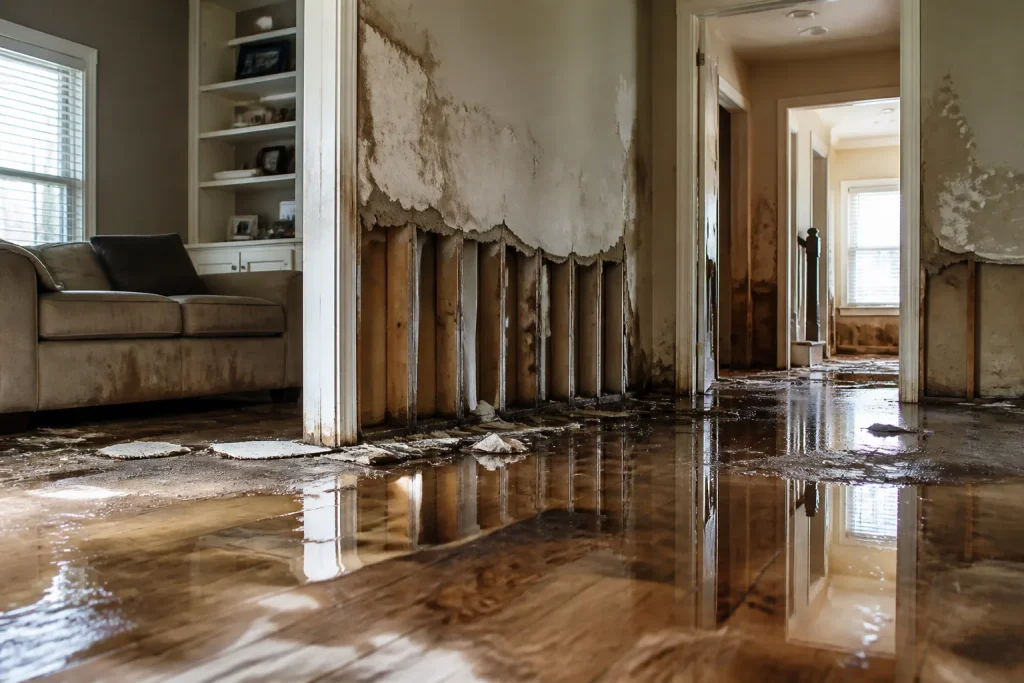
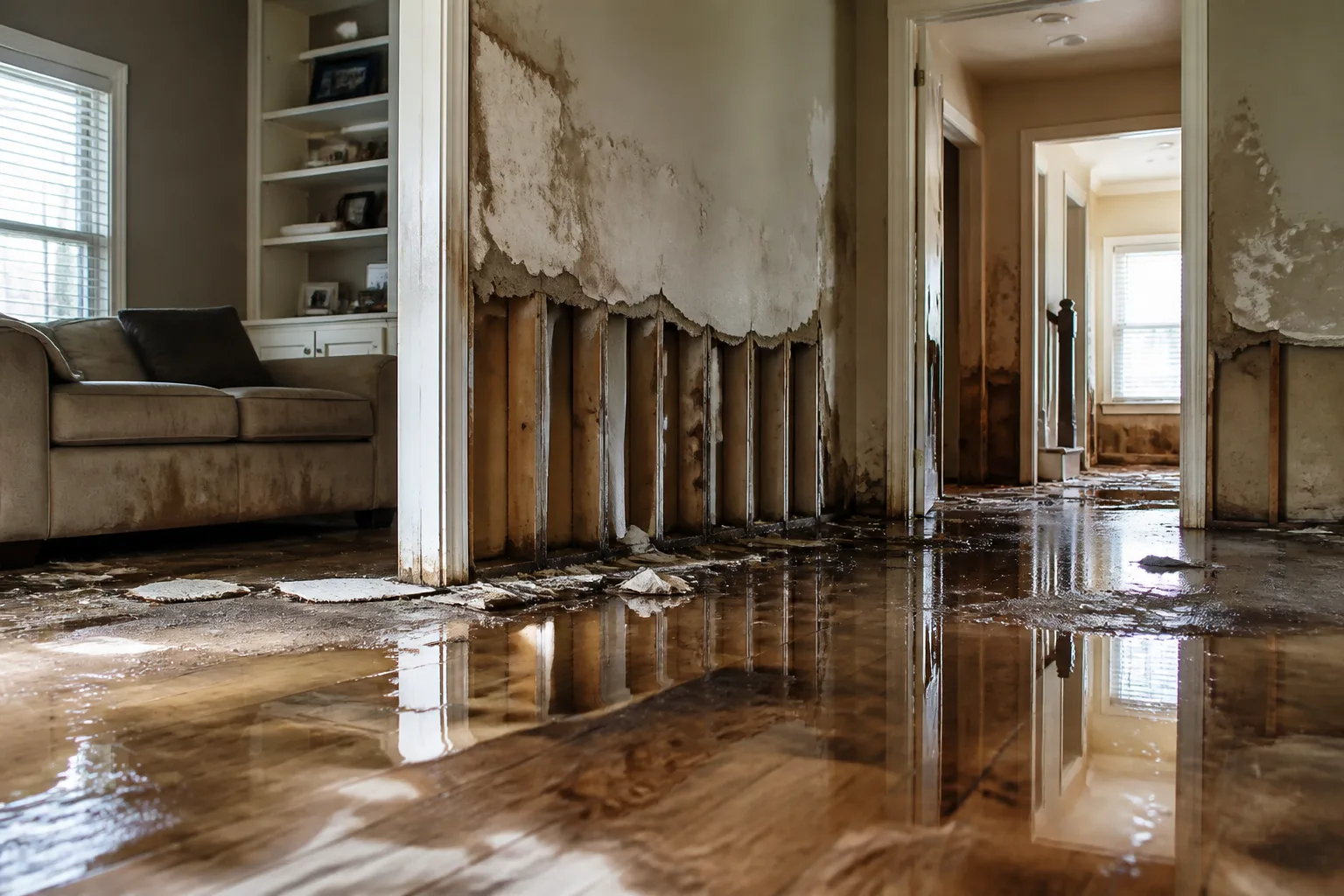
- Wide shots from the doorway first, showing the full extent of standing water or wet drywall in relation to furniture and walls. The insurer needs the room’s story, not a close-up.
- Detailed shots of the source, whether it’s a burst supply line under a kitchen sink or a failed water heater in a garage. The source tells the adjuster whether it’s a covered event.
- Anything already damaged, from buckling hardwood to a waterlogged sofa. If it was in the room when the water hit, photograph it where it sits.
- Vertical shots along walls, even if they look dry. Water wicks upward. The floodline mark may not appear for another hour, but the photo you take now shows what the wall looked like at minute ten.
Keep the photos on your phone. You’ll have them when the adjuster asks, and you’ll have them if the first contractor on site tries to expand the scope later.
Minutes 15-30: The Two Categories Rule
Here’s the most overlooked rule in the business, and it’s one we teach every customer. In the first fifteen minutes, move four categories of items. Leave two categories exactly where they sit.
Move these four categories now:
- Paper and photographs. Irreplaceable documents, tax records, family photos. Get them dry and flat within twelve hours or they’re gone.
- Electronics. Laptops, chargers, anything with a circuit board that hasn’t been submerged yet. If it’s already been underwater, don’t turn it on. Set it aside for pro-level drying with desiccants.
- Small furniture you can lift without strain. Wooden chairs, side tables, anything that will wick water and leave permanent rings on carpet or wood.
- Medications and valuables. Prescriptions, jewelry, cash, anything that’s hard to replace and wrong to leave sitting in a humid room.
Leave these two categories where they are:
- Wet carpet and padding. Pulling carpet up yourself before a professional documents the damage can void a claim. Padding holds water like a sponge. If you rip it out and toss it on the curb, the adjuster can’t verify what was there. That can cost you full replacement value.
- Water-stained drywall and baseboards. The staining pattern tells us exactly where the water traveled. Once you tear it out, that evidence is gone, and the adjuster’s estimate gets smaller, not bigger.
We pulled a job out of a garage over in Kirkwood last year where the homeowner had spent two hours moving waterlogged boxes to the driveway before taking a single photo. The adjuster couldn’t verify three thousand dollars in damaged tools, and the claim got slashed. Twenty minutes of bailing water cost him two grand. Don’t make that trade.
What to Say to Your Insurer Before You Call a Contractor
There’s a specific script that works better than any other when you’re on hold with a claims department at 2 a.m. The person on the other end hears dozens of panicked calls a day. The more precise you are, the faster your file moves.
Use this phrasing, in this order:
- “I have a water damage event at [address].”
- “The source is [a burst supply line to the second-floor bathroom/a failed 50-gallon water heater in the garage/a storm-sewer backup into the finished basement].”
- “I’ve shut off the main water supply.”
- “I’ve photographed the affected areas from the doorway and at the source.”
- “I’ve selected a mit release.”
- “I need a claim number and the name of the adjuster who will be assigned.”
That last line matters more than most people realize. Mitigation release is the phrase that tells the insurer you’re authorizing a restoration company to begin emergency work before the adjuster has visited. Say it clearly. If you call a contractor first and they start extraction before you’ve opened a claim, you can end up fighting the carrier about pre-authorization. Say “mit release” in the first call and you’ve protected the claim.
Call the insurer first. Then call us. That’s the order.
The First Contractor on Site Has Outsized Influence Over the Job
Here’s a dynamic most Atlanta homeowners don’t see coming. The first restoration company to walk through the door effectively sets the scope of the entire job. The moisture map they draw on day one, the readings they take, the way they categorize the damage, becomes the baseline the adjuster works from.
That’s why the authorization language matters. Before any extraction equipment is turned on, insist on a written scope that includes:
- The specific areas of the home affected.
- The category of water involved (clean, gray, or black).
- The target dry standard, which in Atlanta’s climate typically means bringing indoor relative humidity below 45% and moisture content in materials below 15%.
- A line item for daily moisture readings, not just a rental fan left running for a week.
- A promise of updates to the insurance carrier without the homeowner playing messenger.
If a contractor shows up and turns on fans without putting anything in writing, you’ve got a problem. Good companies write the scope before they write the invoice. We’ve been doing this since Curt Bowman founded Floodline Restoration Co. in 2010, and the rule has never been bent: no equipment runs until the homeowner has a written scope in hand and the carrier has a copy.
The 2 a.m. Scenario: What a Real 24-Hour Crew Can Actually Do in Stonecrest
Let’s be honest about what happens in the middle of the night, because there’s a wide gap between what a call center promises and what a subcontractor delivers at 7 a.m. the next morning.
A legitimate 24-hour restoration company with live dispatch can get a certified, background-checked, uniformed technician to your door in Stonecrest, Decatur, East Atlanta, or anywhere else in the metro within about an hour of your call, even at 2 a.m. That technician arrives in a stocked truck with professional-grade extraction and drying equipment: Dri-Eaz dehumidifiers, Phoenix axial air movers, XPOWER injection systems. The goal on a 2 a.m. call is extraction, not full drying. Getting the standing water out before it wicks up drywall and under baseboards is the emergency. The drying phase can wait until the next morning, when flooring and wall cavities can be assessed with the right tools.
A call center, by contrast, is answering phones in another state. The operator takes your name and address, promises a local crew will call you back, and then pages a subcontractor who might show up at 7 a.m. with whatever equipment was left in the back of a pickup. Subcontractors don’t carry Injectidry systems for drying wall cavities. They don’t carry floor-mat systems for hardwood. They carry a couple of fans and a box-store dehumidifier.
You don’t want that trade. The fastest path to a fully dry house in Atlanta is a company whose own crews answer the phone, not a dispatcher in Phoenix.
Why DIY Fans and Box-Store Dehumidifiers Make Georgia Water Damage Worse
This one catches Atlanta homeowners by surprise every summer. The logic sounds right: rent a couple of squirrel-cage fans from the hardware store, run a dehumidifier from the home improvement aisle, and save on the restoration bill. But the vapor pressure dynamics in a humid Georgia summer make consumer-grade equipment actively counterproductive.
Here’s the problem. A box-store dehumidifier pulls maybe 20 to 30 pints of water from the air per day under ideal conditions, and that’s usually overstated. A professional-grade Phoenix dehumidifier pulls 80 to 100 pints per day, and we’ve used them to dry a 2,000-square-foot basement in two days. A consumer-grade unit, running in a sealed room, raises the temperature and moistens the air without actually removing enough water vapor from building materials. The water stays in the drywall, the hardwood, the subfloor. What you’ve done is create a warm, humid box that feeds microbial growth in the exact materials you were trying to dry.
In Atlanta’s July humidity, the outdoor air itself is nearly saturated. Running box-store fans in a closed room with a consumer dehumidifier just circulates wet air over wet materials. Enclosed spaces, especially basements in neighborhoods like Virginia-Highland and Morningside with older foundations, trap that vapor. Mold follows within two to five days. The Dri-Eaz equipment we run doesn’t just pull moisture from the air. It’s sized to the cubic footage of the space, placed to create negative pressure, and monitored daily until the dry standard is met. That’s the part a rental machine can’t do.
If you’re in the first hours of a water event and you can’t reach anyone, the best thing you can do is open windows if the outdoor air is dry, which in Atlanta means basically never between June and September. Otherwise, shut the door to the affected room, keep the HVAC running if it’s safe, and wait for the pros.
When to Call a Pro
There are water events you can handle with a mop and some towels, and there are water events that need extraction equipment before sunrise. Here’s the simplest way to tell the difference.
Call a professional restoration company when:
- Standing water covers more than a few square feet, especially if it’s in a finished basement, under hardwood, or against drywall.
- The water came from a sewage backup, a toilet overflow, or a storm drain. That’s Category 2 or Category 3 water, and it carries bacteria that no mop solution is going to neutralize.
- The water has been sitting for more than an hour and has started to wick up walls or under baseboards.
- The affected area is anywhere near electrical outlets, the breaker panel, or gas appliances.
- You smell anything other than clean water, which often means the event has started to transition into a mold problem.
If you’re unsure, call us at (888) 832-2758. We’ll ask you a few questions and give you a straight answer about whether you need extraction tonight or a wet-dry vac in the morning. The call is free, and a live person answers it, even at 2 a.m.
For Atlanta homeowners dealing with related issues, we also handle Mold Remediation in Stonecrest, Fire & Smoke Damage Restoration in Stonecrest, and full Water Damage Restoration in Stonecrest.
The Bottom Line
The thirty minutes after you discover water damage in your Atlanta home decide whether you’re dealing with a three-day dry-out or a three-week rebuild. Shut off the main valve, photograph every surface before you move anything, call your insurer and say the words “mitigation release,” then call a company that puts the scope in writing before it turns on a fan. Move the paper, the electronics, and the small furniture. Leave the wet carpet and the stained drywall exactly where they sit so your adjuster can see the evidence.
If you’re in Atlanta and dealing with water damage right now, Floodline Restoration Co. of Atlanta offers free estimates and live dispatch around the clock. Call (888) 832-2758 and you’ll get a person, not a recording. We’ve been doing this since 2010 with the same name on the door.
Frequently Asked Questions
With a live dispatch operation like ours, a certified technician typically reaches most Atlanta neighborhoods within an hour of your call, even overnight. A real 24-hour company sends its own employees, not a subcontractor who fits you in after other jobs. If a call center promises a callback, plan on seeing someone at 7 a.m. at the earliest.
Most standard Atlanta homeowners policies cover sudden and accidental water events, like a burst pipe or a failed water heater, but they commonly exclude slow leaks and floodwater from outside. The fastest way to protect the claim is to say “mitigation release” on your first call to the insurer, which authorizes emergency work before the adjuster arrives.
In Georgia’s humid climate, consumer-grade fans and box-store dehumidifiers can make the problem worse by heating the air and circulating moisture without removing it from building materials. Professional equipment, sized to the room and monitored daily, is what actually dries the structure before mold takes hold.
Shoot wide shots from the doorway first, then detailed photos of the source, then anything already damaged, then vertical shots along the walls. Photograph wet carpet and water-stained drywall where they sit before moving anything. The evidence is worth more than the cleanup.
Written by Curt Bowman, Owner at Floodline Restoration Co. of Atlanta home, serving Atlanta since 2010.
Need Damage Restoration Help?
Call Floodline Restoration Co. of Atlanta - licensed & insured, available 24/7 in Atlanta.
(888) 832-2758