
IICRC Water Damage Restoration in Atlanta: A Homeowner’s Guide
The IICRC S500 standard runs 180 pages, but the single number that determines whether your home dries correctly – the psychrometric target for relative humidity – almost never gets written on any document the homeowner receives. That’s a problem, because without a written drying goal, you can’t verify anything. Here’s what the S500 actually requires, translated into what you can see, smell, and check on your own floor. If you’d rather skip the reading and have someone handle it, call (888) 832-2758.
The Three IICRC Water Categories: Why Misclassification Happens in Atlanta
The S500 divides water into three categories. Category 1 is clean water from a supply line or a broken faucet. Category 2 is gray water – washing machine discharge, dishwasher overflow, or sump pump failure. It carries biological contaminants but not sewage. Category 3 is black water: sewage, floodwater from outside, or anything that has sat in a warm Atlanta summer for more than 72 hours. Each category determines how much of the structure gets removed versus dried in place.
In Atlanta, the clay sewer lines in older neighborhoods like Virginia-Highland, Grant Park, and Kirkwood are a known problem. Clay pipe shifts, cracks, and tree roots get in. When that happens, what starts as a clean water supply break can get contaminated by sewer effluent backing up through the slab. We’ve seen this happen enough that we treat any water that has contacted a floor drain or a toilet in a 1950s-1970s neighborhood as Category 3 until proven otherwise. Contractors who skip the category assessment and start drying are costing the homeowner money – either through incomplete cleanup or an insurance claim that gets denied later because the classification wasn’t documented. If the water came from outside, or if it smells like sewage, it’s Category 3. No exceptions. A crew that doesn’t say this out loud is not following the standard.
What a Moisture Log Actually Is (and Why a Compliant Crew Produces One Automatically)
A moisture log is not a note on a clipboard that says “checked, looks dry.” Under S500, a proper log records the date, the specific room, the material tested (drywall, subfloor, hardwood, carpet pad), the instrument used (moisture meter, thermo-hygrometer, penetrating probes), the reading, and the technician’s name. It gets updated daily. The homeowner gets a copy. The insurance carrier gets a copy. There is no asking for it – a certified crew produces one because the standard requires it. If a contractor hesitates when you ask to see the log, that hesitation tells you something.
We run daily readings on every water job in Atlanta, whether it’s a condo in Midtown or a split-level in Decatur. The log tracks two things: moisture content in building materials, measured as a percentage, and relative humidity in the air, measured with a thermo-hygrometer. The S500 says you dry until wood reaches its dry standard for the region – in Georgia, that typically means hardwood floor below 12% moisture content and subfloor below 16%, though the numbers vary by species and the original condition. The point is, there is a number written down, and a crew follows it until the log shows the target is met. That’s the difference between drying and guessing.
The Four Drying Phases in the S500: What Equipment Should Be in Your Home
The S500 breaks drying into four phases, and each phase has equipment that should be physically present. Homeowners in Atlanta who know what to look for can verify compliance by walking the house.
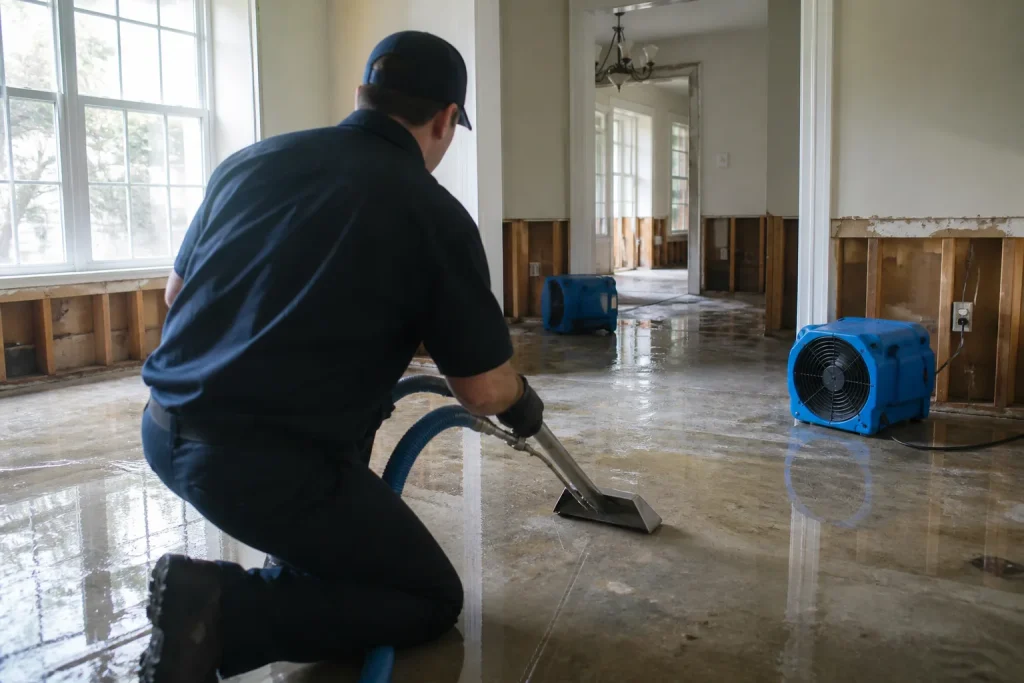
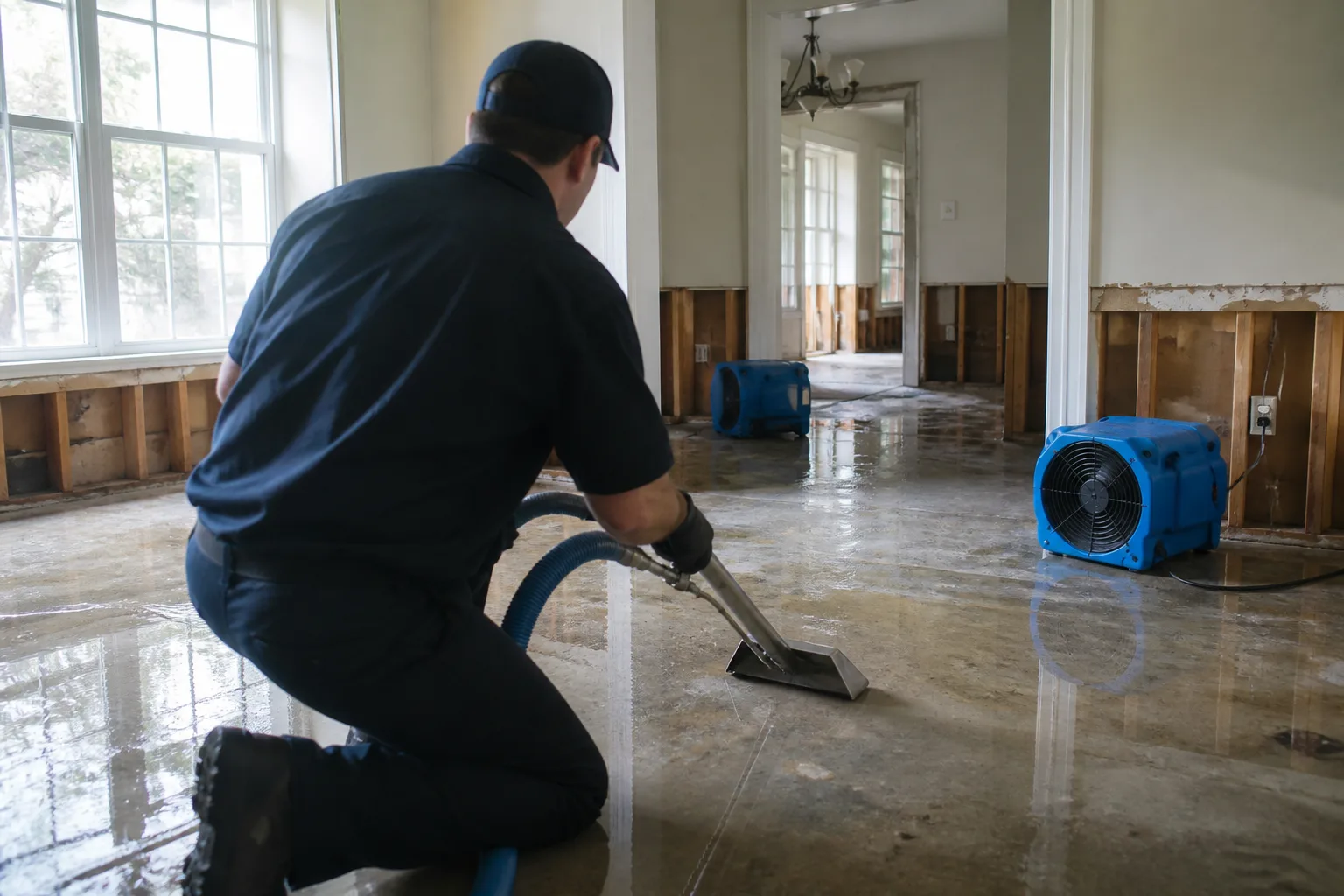
- Phase 1: Water removal (emergency extraction). A truck-mounted extraction unit or a high-volume portable extractor removes standing water. Carpet padding gets pulled out and discarded. Baseboards may be removed. Hardwood floors get drying mats placed over them if they’re salvageable. You should see water being removed within hours, not days.
- Phase 2: Evaporation. Air movers – XPOWER and Dri-Eaz are two brands we run – are positioned to move air across wet surfaces. The exact number depends on the square footage, but one air mover per room is a minimum for a small room, more for larger spaces. You should feel steady airflow across every wet surface.
- Phase 3: Dehumidification. A refrigerant or desiccant dehumidifier, typically a Phoenix or B-Air unit, pulls moisture from the air. The unit’s drain hose runs to a sink, toilet, or outside. If you see air movers but no dehumidifier running, that’s a red flag – evaporation without dehumidification just pushes moisture into the dry parts of the house.
- Phase 4: Verification. Daily moisture readings confirm materials are reaching target. Equipment gets repositioned or removed as areas dry. The crew adjusts fan placement and dehumidifier settings based on the log, not on a timer. The job is done when the numbers say it’s done.
In Atlanta’s humid climate, dehumidification is not optional. Relative humidity outside runs 70-90% through most of the summer. A crew that skips the dehumidifier is air-drying your walls with swamp air. The S500 requires the indoor relative humidity to be managed to whatever the psychrometric conditions demand – and in August in Atlanta, that means a serious dehumidifier running around the clock.
IICRC Certification vs. IICRC Membership: The Two-Minute Test
This is one of the most misunderstood distinctions in restoration, and unscrupulous contractors lean on it. The IICRC is a certification body. It certifies individuals – a technician completes a course, passes an exam, and earns a certification like Water Damage Restoration Technician (WRT) or Applied Structural Drying (ASD). The IICRC does not certify companies. A company cannot be “IICRC certified.”
What a company can be is IICRC-certified in the sense that it employs certified technicians. But some contractors pay a membership fee to an industry association and then write “IICRC member” on their truck. Membership is not certification. A membership card doesn’t mean anyone on the crew has completed a single hour of training. When you call a contractor in Atlanta, ask these questions in this order: “Are your technicians IICRC certified? Which certifications do they hold? Can I see a copy of the certification?” A technician who holds a WRT or ASD certification will have a numbered card or certificate. If the answer is “we’re IICRC members” or “we follow IICRC standards,” that’s not the same thing. At Floodline Restoration Co. of Atlanta, our technicians carry IICRC, RIA, and IFA certifications, and we’ll show you the paperwork without being asked. A company that bristles at the question has answered it for you.
How the S500 Interacts with Georgia Insurance Claim Documentation
Georgia insurance policies require proof of loss, and a disputed water claim often comes down to whether the drying was done to a recognized standard. The S500 is that standard. Here’s where the moisture log matters beyond the drying itself: when a carrier questions whether additional demolition was necessary, or whether hardwood could have been saved, the log is the evidence. A moisture log that shows daily readings, signed by a certified technician, documenting failure to reach the dry standard by day three, supports the decision to remove materials. A claim with no log is a homeowner arguing with an adjuster over a verbal promise.
This is also why direct insurance billing matters. When a restoration company bills the carrier directly and provides photo documentation, the moisture log, and a written scope of work, the claim moves faster. The homeowner never has to play messenger. If you’re in Atlanta and your water claim involves a Category 3 loss – sewage backup into a finished basement in Brookhaven, for example – the documentation standard is higher. Your restoration contractor should be able to hand the adjuster a packet that answers every question before it’s asked. That’s not extra service. Under S500, it’s part of the job.
Related services in Atlanta: If water damage has led to mold concerns, see our Mold Remediation in Stonecrest page. For damage from a house fire, visit our Fire & Smoke Damage Restoration in Stonecrest page. And for full-service water work in that area, see Water Damage Restoration in Stonecrest.
When to Call a Pro (and When a Shop Vac Will Do)
A toilet supply line that breaks while you’re home and gets shut off within minutes – that’s a mop and a fan job. A supply line that breaks while you’re at work and runs for eight hours into a finished basement – that’s a restoration job. The line is simple: if water has saturated drywall, soaked into hardwood, or pooled under cabinets, you need extraction equipment and a drying plan. The S500 standard applies once structural materials are wet. Before that, it’s cleaning. After that, it’s a science with checkpoints.
We pulled a washing machine out of a laundry room over in East Atlanta last month where the supply hose had been leaking behind the machine for weeks. The homeowner had noticed a musty smell but assumed it was old towels. By the time we pulled the baseboards, the bottom 18 inches of drywall was at 40% moisture content and the studs were wicking water up from the slab. That’s a Category 2 at minimum, and it required two weeks of drying and a partial rebuild. The smell was the first checkpoint. The meter confirmed what the nose suspected. If you can smell it, the water has been there longer than you think.
Floodline Restoration Co. of Atlanta home has been serving Atlanta since 2010. We’re the full-cycle restoration company that starts at the floodline – the honest mark the water left on the wall – and doesn’t hand the job off until extraction, drying, and rebuild are finished by the same certified crew. The moisture log and the 90-Day Done Right Promise are in your hands before we leave. If you’re in Atlanta and dealing with water in your home, call (888) 832-2758. A live person answers, 24/7, and the estimate is free.
The Bottom Line
The IICRC S500 standard is a specific drying protocol, not a slogan. Homeowners in Atlanta who understand the four drying phases, the three water categories, and what a compliant moisture log looks like can tell in real time whether a crew is actually following the standard – or just saying they are. The key checkpoints are simple: water extracted promptly, air movers and dehumidifiers both running, daily written readings, a clear water category assessment, and certified technicians who can show the paperwork. If any of those are missing, the job isn’t being done to standard.
If you’re in Atlanta and need help, Floodline Restoration Co. of Atlanta offers free estimates – call (888) 832-2758.
Frequently Asked Questions
IICRC stands for the Institute of Inspection, Cleaning and Restoration Certification. It writes the S500 standard, which is the water damage restoration industry’s authoritative protocol for how water-damaged structures are assessed, dried, and repaired. A technician who is IICRC-certified has completed training and passed an exam showing they know how to dry a structure correctly, not just move fans around. In Atlanta, where high humidity complicates drying, hiring certified technicians matters because improper drying leads to hidden mold and failed insurance claims.
Water is Category 3 if it contains sewage, came from outside flooding, or has been standing in a warm structure for more than 72 hours. In Atlanta, aging clay sewer lines make sewage backup a common source of Category 3 water in older neighborhoods. If the water smells like sewage, came from a toilet overflow, or sat for days before discovery, treat it as Category 3. That means removing affected porous materials, not just drying them. Call (888) 832-2758 for an assessment – estimates are free.
Most Georgia homeowners policies cover sudden and accidental water damage, which includes most supply line breaks and appliance failures. Gradual leaks – the kind that runs for weeks behind a wall – are typically excluded. The key to a successful claim is documentation: a moisture log, photo evidence, and a written scope of work from a certified technician. Floodline Restoration Co. of Atlanta bills your carrier directly and provides the documentation the adjuster needs. Call (888) 832-2758 to discuss your specific policy.
In Atlanta, response time matters because warm, humid conditions accelerate mold growth and structural damage. Floodline Restoration Co. of Atlanta answers the phone with a live dispatcher 24 hours a day, 7 days a week, and a certified crew is dispatched immediately. Extraction starts on the same visit in most cases. If water is spreading through your home right now, call (888) 832-2758 and get someone on the way.
Written by Curt Bowman, Owner at Floodline Restoration Co. of Atlanta, serving Atlanta since 2010.
Need Damage Restoration Help?
Call Floodline Restoration Co. of Atlanta - licensed & insured, available 24/7 in Atlanta.
(888) 832-2758